
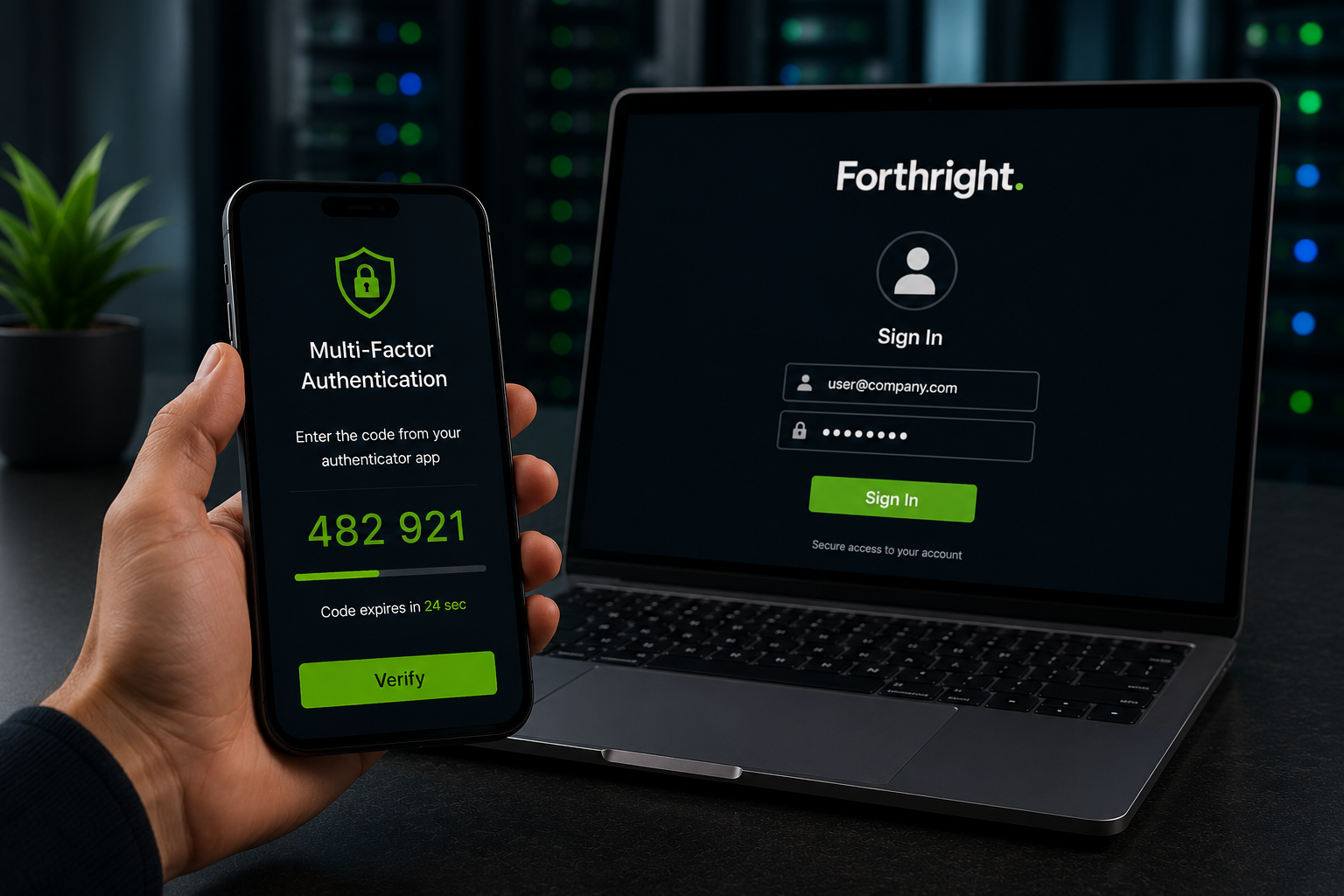
Require MFA for Externally‑Exposed Applications
This article is part of our ongoing CIS IG1 series focused on practical, high‑impact security controls. In this section of the framework, identity takes center stage. Rather than focusing on new tools or complex architectures, CIS IG1 emphasizes a simple idea: access should always be verified, especially when systems are exposed to the internet.
The CIS IG1 safeguards around identity begin at the most obvious boundary: externally‑exposed applications. Email portals, cloud platforms, customer‑facing systems, and line‑of‑business web applications are designed to be reachable from anywhere. That accessibility is what makes them valuable to the business, but it is also what puts them squarely in an attacker’s sights.
Passwords alone are no longer sufficient protection for these systems. Credential theft through phishing, password reuse, and third‑party breaches has become routine. When an externally‑exposed application relies only on a username and password, access effectively hinges on a single control that is frequently compromised.
Multi‑factor authentication changes that dynamic. Even when credentials are stolen, MFA introduces a second barrier that attackers cannot easily bypass. This is why CIS IG1 explicitly prioritizes MFA for externally‑exposed applications. The objective is not to eliminate risk entirely, but to prevent a common failure mode from becoming a business‑impacting incident.
This safeguard is particularly important for SaaS platforms that store sensitive data or provide access to other systems. Email, file sharing platforms, finance and HR applications, and customer portals should all be evaluated through this lens. If an application is exposed to the internet and its compromise would matter to the organization, MFA should be enabled.
From an operational standpoint, this is one of the highest return security improvements an organization can make. Most modern platforms support MFA natively, meaning deployment often comes down to configuration rather than a large technology initiative. The user experience impact is typically minimal, while the risk reduction is substantial.
There is also an audit and defensibility benefit. Regulators, cyber insurers, and customers increasingly view MFA on externally‑exposed applications as a baseline expectation. Enabling MFA demonstrates that the organization understands modern threat patterns and has taken reasonable steps to protect publicly accessible systems.
IG1 in practice, organizations usually start with email and their most widely used SaaS platforms. The focus is on systems that are both externally accessible and business‑critical, rather than attempting to enable MFA everywhere at once. By using native application controls or a centralized identity provider, many organizations close this gap quickly while keeping disruption low.
Securing externally‑exposed applications is often the first step in strengthening identity controls, but it is not the last. Once users authenticate successfully, the next question becomes how access is extended into the internal environment. That is where the next CIS IG1 safeguard builds on this foundation by focusing on remote network access.